
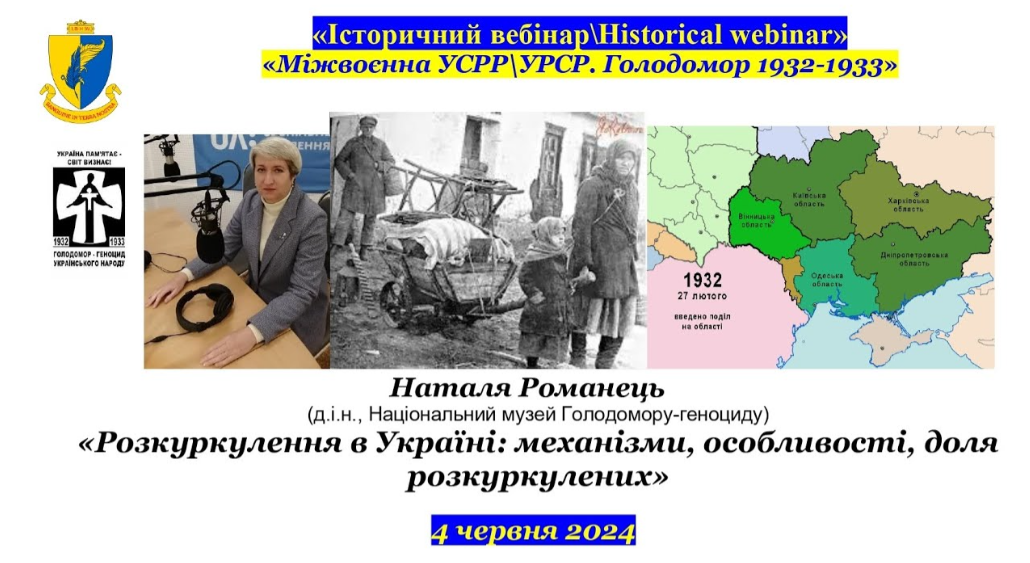
“Historical webinar,” section “Modern era. Holodomor 1932-1933,” presented a webinar with the participation of a researcher of the Holodomor of 1932-1933 in Ukraine, Doctor of Historical Sciences, Nataliia Romanets.
Dekulakization, which the authorities used as the essential tool for implementing complete collectivization, became the first mass repressive operation during the “second communist assault” (1929–1933). During the campaign to “liquidate the exploitative strata of the village,” the Kremlin worked out mechanisms for the imprisonment and deportation of large numbers of people, which were soon used during the grain procurement campaign of 1932–1933 and the Great Terror of 1937–1938.
Dekulakization consisted of four interconnected punitive actions: the removal of “rural criminals” and “counter-revolutionary elements,” the deportation of peasants to the Northern regions of the USSR, and resettlement to kulak settlements within the republic. Dekulakization caused tectonic shifts in the existence of the Ukrainian peasantry, even those social groups that did not become victims of this repressive operation. The threat of being classified as a kulak hung over them for the next decade, regardless of their actual social status.
You can watch the webinar here: