
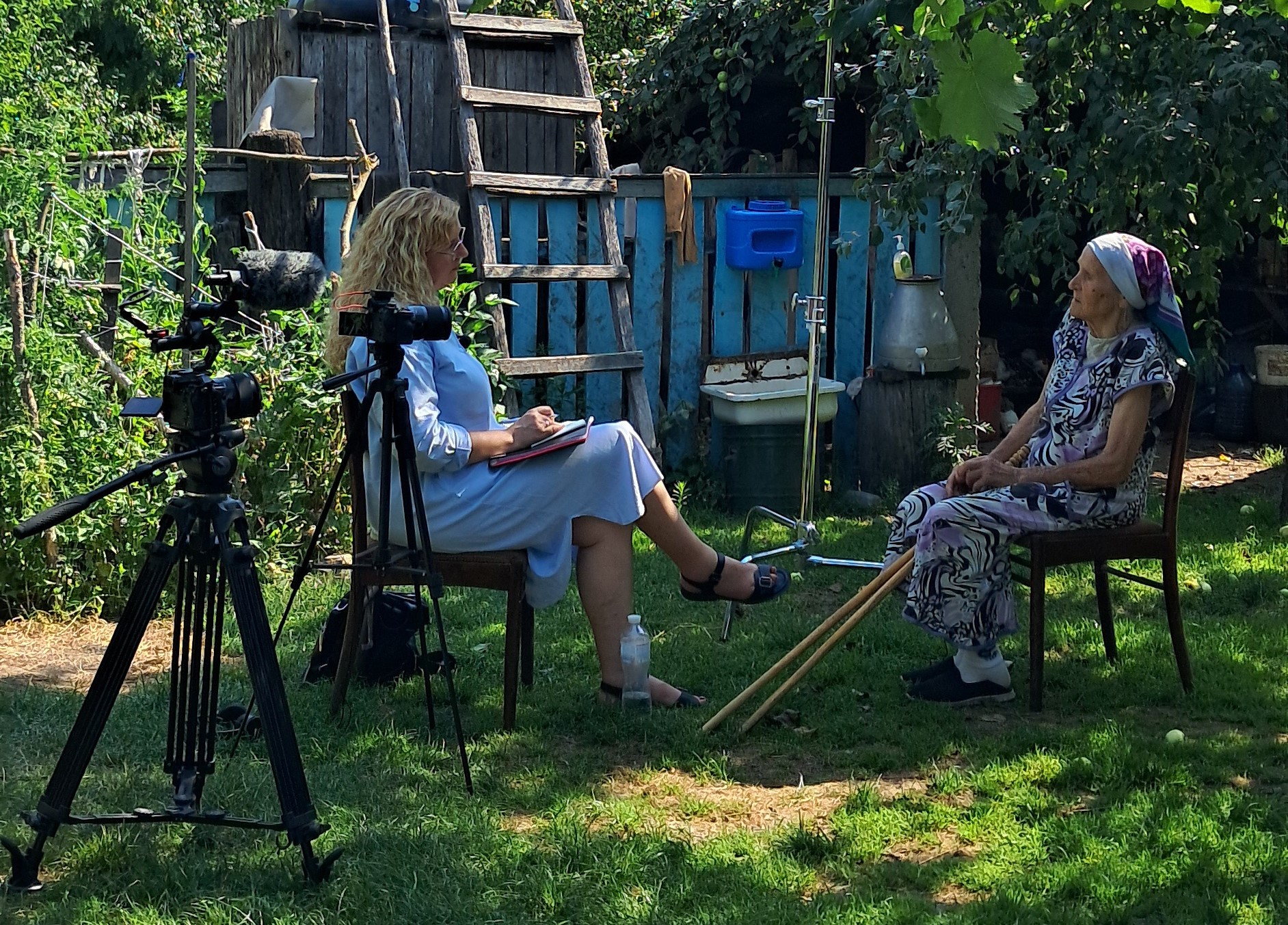
In the last month of summer, the museum team embarked on another expedition. Over three weeks of field research, our colleagues from the Holodomor Oral History Department travelled more than four thousand kilometres, visiting 38 settlements across four regions: Chernihiv, Cherkasy, Odesa, and Khmelnytskyi. During the expedition, they recorded the testimonies of 76 respondents, survivors of the Holodomor and the mass man-made famine that occurred from 1946 to 1947.
Every region, every village, and every encounter left a deep impression and evoked strong emotions. In the village of Lypiv Rih in the Vertiivska community of the Nizhyn District in the Chernihiv region, we had a conversation with Maria Illivna Krysa. Mariia was born during the hungry year of 1933 and survived the postwar famine of 1946–1947. She showed us her most cherished family heirlooms: a skirt, an embroidered shirt, and her mother’s necklace, which the family managed to preserve despite those harsh, hungry years.
In the village of Strilnyky, part of the Bakhmach community in the Nizhyn District of the Chernihiv Region, we met the oldest interviewee of this expedition, 102-year-old Mariia Andriivna Riabokon. In the village of Lymanke, in the Rozdilna District of the Odesa Region, we talked to Volodymyr Stepanovych Radovskyi, born in 1938. He told us how, against his stepmother’s wishes, he shared his bread with a neighbour’s daughter, Nelia, who later became his wife.
In the village of Sharivka in the Khmelnytskyi region, we documented a story of saving villagers during the Holodomor. In 1932, after receiving an order to give all the grain to the state, the collective farm head, Volodymyr Kosak, gave the grain from the collective farm’s granary to the people and told them to hide it. That saved the village from starvation.
During these trips, we also supplemented our museum collection. Marusia Kyrylivna Semeniuk, born in 1935 in the village of Irzhavets within the Ichnia community of the Pryluky District in the Chernihiv region, donated two towels that she had embroidered herself. Additionally, she contributed a towel that she wore at her wedding, which she received from her mother.
Fedir Ivanovych Umanets, born in 1940, has preserved and shared unique documents belonging to his father, who was deported to Siberia in 1933. He also donated documents from his dekurkulised grandfather, including the original 1910 land survey map of the village, with a marked plot of land that belonged to their family.
Our expedition took place as part of the project “Support for the National Museum of the Holodomor-Genocide in Ukraine,” implemented by Cowater International in partnership with the Canada-Ukraine Foundation and funded by Canada’s International Development – Global Affairs Canada.
We want to highlight that this was our first research trip using our very own museum vehicle! The spacious and comfortable car, purchased for the museum by our Canadian partners, will continue to assist us with our work.
What’s more, this crucial trip was made possible with the support of the OKKO petrol station chain.
We appreciate everyone who was involved in making this project a reality! We still have two weeks left in our expedition, so stay tuned for more updates!
Щиро дякуємо всім, хто долучився, аби цей задум було реалізовано! Попереду – ще два тижні експедиції! Отже – далі буде!