
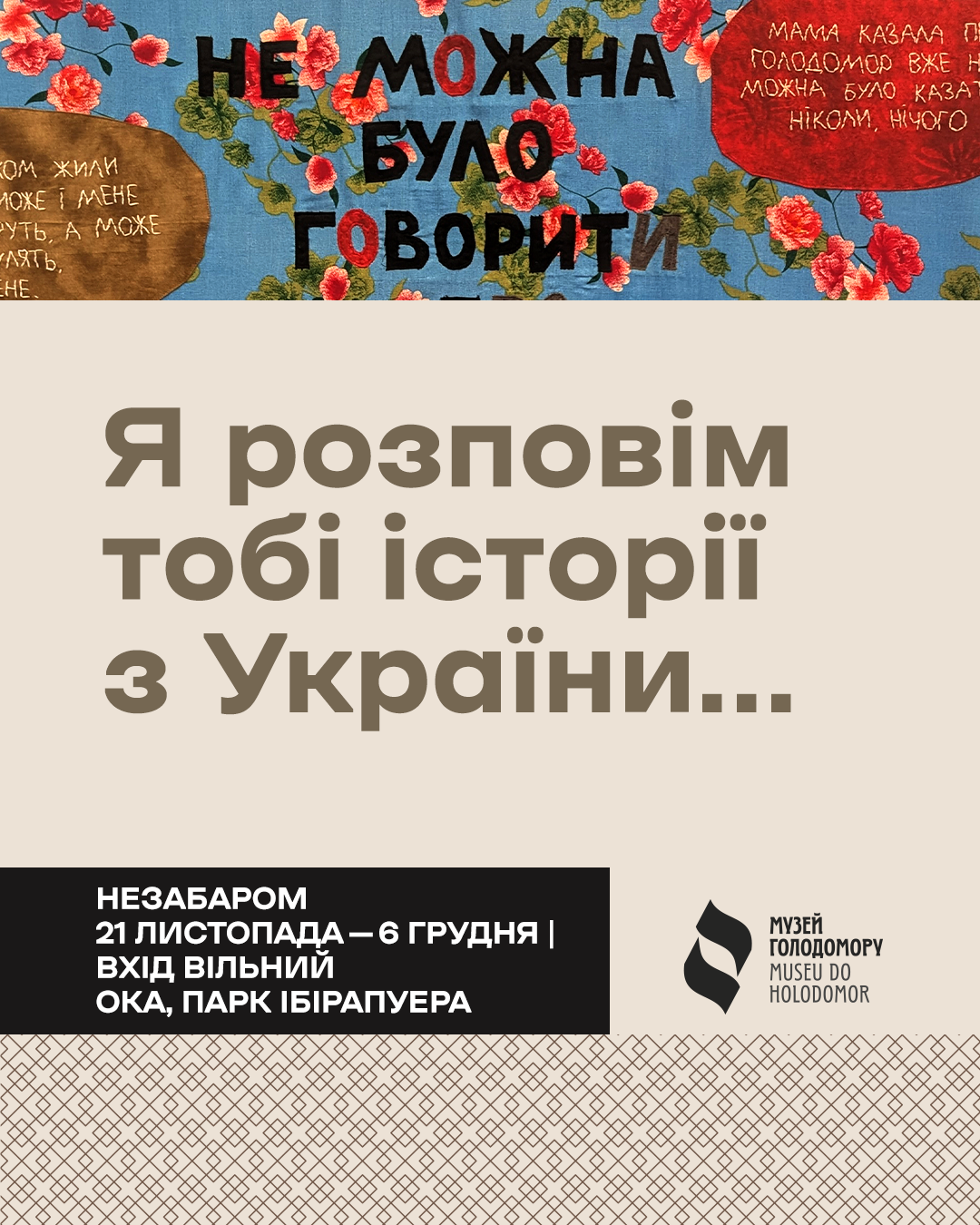
On 21 November, the exhibition ‘I Will Tell You Stories from Ukraine…’ by the National Museum of the Holodomor-Genocide is due to open at the Oca exhibition pavilion in Ibirapuera Park, São Paulo. The exhibition is being held under the auspices of the Embassy of Ukraine in Brazil and as part of the project ‘Support for the National Museum of the Holodomor-Genocide’, implemented by Cowater International in partnership with the Canada-Ukraine Foundation and funded by the Canadian Ministry of Foreign Affairs. The exhibition will run until 6 December. Admission is free.
Ukrainian projects are rarely showcased in the Brazilian cultural scene, which makes the exhibition ‘I Will Tell You Stories from Ukraine…’ particularly intriguing. The curators offer a conceptual exploration of the experiences of individuals who have witnessed historical upheavals resulting from global changes. This exhibition is taking place at the Oca pavilion in São Paulo, a space designed by Oscar Niemeyer, one of the most significant architects of the 20th century. The curators transform this fantastical space into a tapestry of narratives from various eras, allowing visitors to discover stories that resonate with their own emotions.
Staff at the National Museum of the Holodomor-Genocide tell one such story. Today, they are restoring the previously suppressed truth about the genocide perpetrated in Ukraine by the Stalinist regime in 1932–1933. Its name, the Holodomor, combines the Ukrainian words for ‘famine’ and ‘death’, emphasising the deliberate nature and scale of the crime. During their expeditions, the museum staff collected thousands of testimonies from people who survived this terrible ordeal. These survivors found the strength to carry on and preserve their personal stories, which are now woven into the collective memory of an entire nation.
‘Through this exhibition, we aim to introduce the Brazilian public to Ukraine through the stories of its people. Our Museum has collected numerous testimonies from the Holodomor survivors, people who found the strength to rebuild their lives and pass on their memories to future generations. By combining these voices with Oksana Briukhovetska’s artistic reflections, based on family memories, we explore how families preserve their stories and how these stories sustain a nation’s culture, identity, and sense of dignity... ‘Sharing this memory is also a way of affirming the value of freedom and our responsibility to ensure that such crimes are never repeated,’ notes Lesia Hasydzhak, Director General of the National Museum of the Holodomor-Genocide.
Thousands of Ukrainian families preserve their own accounts of the Holodomor, as does the family of the artist Oksana Bryukhovetska. She recounts her story through a handcrafted series of textile collages entitled ‘The Tree of Life, The Tree of Survival’. The Tree of Life symbolises the richness and fertility of the Ukrainian land, where famine is hard to imagine, while the Tree of Survival embodies the trauma that has been etched into the habits of entire generations.
‘My works aim to convey the concepts associated with this historical event through the contrast between abundance and life on the one hand, and the decline and gradual disappearance of food and people on the other. Vibrant colours give way to monochrome silhouettes that express emptiness and loss. The exhibition also explores themes of the silencing of history, the land and repressed memory, intergenerational trauma, and inherited eating habits,’ explains Oksana.
Today, the traumatic historical experience of the Holodomor has taken on tragic relevance in the context of Russian aggression in Ukraine. Additionally, the memory of the Holodomor influences the Ukrainian perception of freedom and dignity, fueling resilience and resistance against any future genocide.
What visitors will see
- ‘The Holodomor: A Mosaic of History. Unknown Pages’. Video testimonies from survivors of the Holodomor in Ukraine, 1932–1933.
- A multimedia presentation on the Holodomor in Ukraine in 1932–1933, based on documentary evidence.
- ‘The Tree of Life, the Tree of Survival’. A series of textile collages by Oksana Briukhovetska.
Visitors will also have the opportunity to take part in the participatory project ‘The Fabric of History’, which involves creating a textile panel that brings together the individual practices of people from different corners of the world. Once the project is complete, it will be handed over to the National Museum of the Holodomor-Genocide.
Curatorial team: Oksana Barshynova, Oksana Briukhovetska, Oleksandr Burlaka, Mykhailo Kostiv, Olha Melnyk (Ukraine)
Technical Director: Andrii Mazuruk (Canada)
Design: Origin Studio (Canada)
About the National Museum of the Holodomor Genocide
The National Museum of the Holodomor-Genocide is the first and only national institution in Ukraine dedicated to researching the genocide of 1932–1933 and honouring the memory of its victims. It currently operates as a memorial Hall of Memory. Construction of its main building had begun but was halted due to full-scale Russian aggression. More about the National Museum of the Holodomor-Genocide:
https://holodomormuseum.org.ua/
Find out more about the history of the Holodomor genocide:
About Oksana Briukhovetska
Oksana Briukhovetska is a Ukrainian artist, curator and writer. She studied at Lviv Ivan Trush College of Decorative and Applied Arts. Between 2021 and 2023, she obtained a Master’s degree in Fine Art from The Penny W. Stamps School of Art & Design at the University of Michigan (USA). She lives and works in Kyiv. Her artistic practice encompasses painting, textiles, curatorial and collaborative projects. Bryukhovetska explores themes of feminism, corporeality, social justice and traumatic memory. She has taken part in numerous exhibitions in Ukraine and abroad. In 2025, her book ‘Voices of Black Lives Matter’ was published, based on interviews documented in the USA during the 2020–2021 protests. After the onset of Russia’s full-scale invasion of Ukraine, Briukhovetska created a series of tapestries titled ‘Songs and Flowers for Ukraine’ (2022–2023), which pay tribute to the tragic moments in Ukrainian history and the experiences of war. Her accolades include the Igor Zabel Award for Culture and Theory (2022) and the Women in Arts Award in the Visual Arts category (2026).
Information for visitors
Exhibition: ‘I will tell you stories from Ukraine…’
Dates: 21 November to 6 December [opening hours to be confirmed].
Venue: Oca Exhibition Pavilion, Ibirapuera Park.
Address: Av. Pedro Álvares Cabral, Entrance No. 2, Ibirapuera, São Paulo, State of São Paulo, Brazil.
Admission is free.