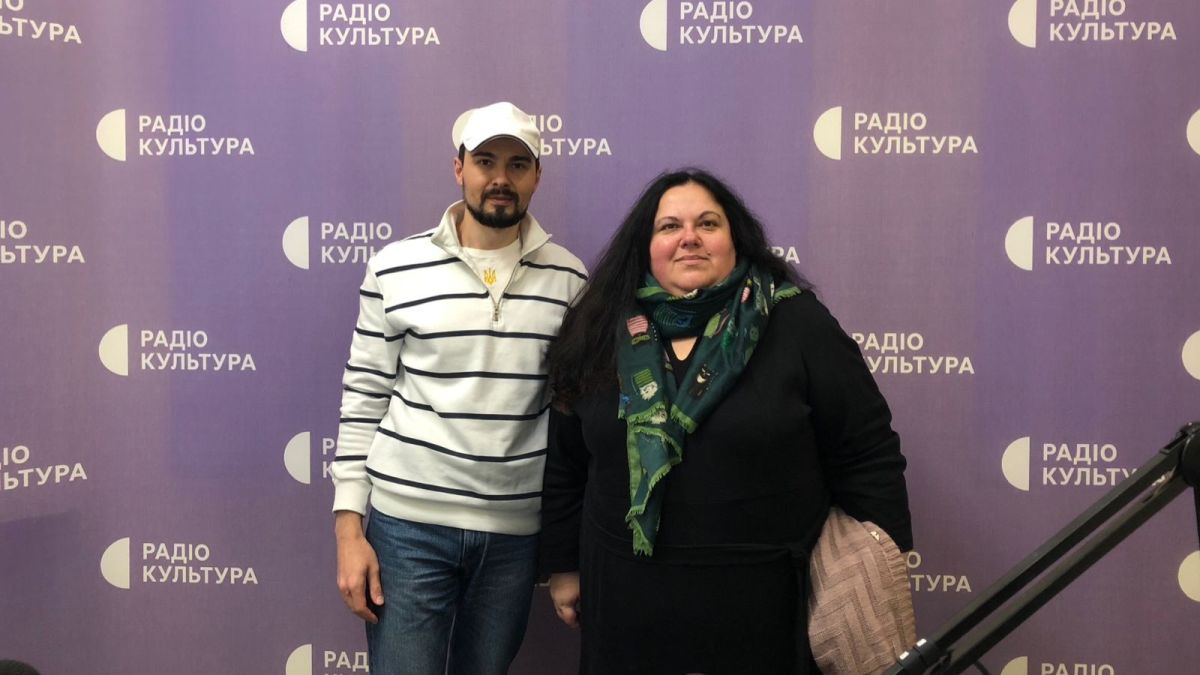
Recording the last witnesses of the Holodomor: Radio Culture on our expedition
The Holodomor Museum expedition “Mosaic of History. Episode Three” continues. The first interim results of the expedition were reported on Radio Culture by the Director General of the National Museum of the Holodomor Genocide, Lesia Hasydzhak, and the expedition leader, head of the Holodomor Oral History Department, Yuliia Kotsur.
“We realised that we were actually the last witnesses of the Holodomor. And this prompted us to organise an expedition,” emphasised the Museum’s Director General Lesia Hasydzhak. “The expedition was initiated following extensive preparations. We appealed to all 900 united territorial communities of Ukraine with a request to provide us with information about these people who survived the Holodomor and famine. I would like to take this opportunity to thank the social workers and employees of the cultural departments who provided us with this mass of information. We processed it and based on it, formed the routes that our colleagues are working on today.”
She noted that the opportunity to conduct such a large-scale project was made possible through the support of our partners, particularly the Government of Canada. They provided funding for transportation, logistics, and the hiring of professional photographers and videographers.
In three weeks, the expedition has already managed to record nearly 150 witnesses to the Holodomor and the mass artificial famine of 1946-1947. Many of them are 90 years old or older.
“A few minutes ago, we finished recording in the city of Zviahil. We recorded Antonina Ivanivna Zapolska, born in 1924,” said expedition leader Yuliia Kotsur via live broadcast from the Zhytomyr region. “Each story is unique and special for us. Although we have already heard and recorded hundreds of such stories. However, each story is a personal experience of a family. An experience of survival. An experience of rescue. Often, this experience is tragic, and it is associated with the loss of relatives. Every family experiences it very hard. When people share their stories, they often relive those difficult moments. Today, while listening to Antonina Ivanivna, we felt her pain deeply. Her father died during the Holodomor, but he did not die from hunger. During the dekulakisation, the family’s entire property was confiscated: their cow, oxen, horse, and all their tools and household utensils. Moreover, the family was expelled from their own home. The father could not stand it and had a heart attack. And the mother and her six children were forced to wander around the village, where no one wanted to shelter them, since it was forbidden to let so-called kulaks into their homes. Only some neighbours sheltered them, thanks to whom the family survived. It was a tragic story for the whole family because two of the mother’s brothers were also dekulikised and sent to Siberia with their families. The father’s brother was beaten to death for picking ears of grain in the field. He was buried in those fields.” She emphasised that such stories are crucial for preserving the national memory of the Holodomor and the famine of 1946-1947.
The expedition is part of the international technical assistance project “Support for the Exhibitions of the National Museum of the Holodomor in Kyiv, Ukraine,” funded by the Department of Foreign Affairs of Canada (Global Affairs Canada, GAC) and implemented by Cowater International and the Canada-Ukraine Foundation.
More information is available on the Radio Culture website.