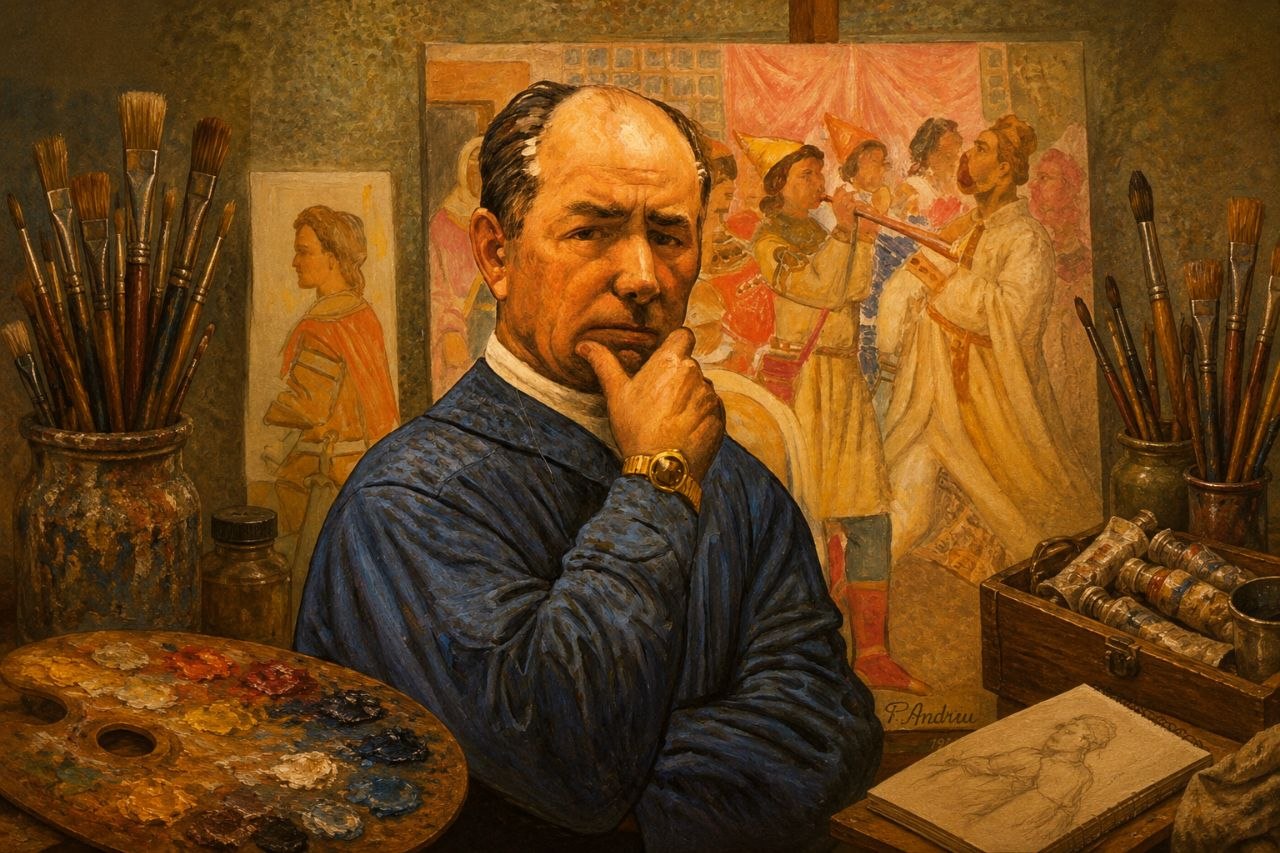
120 years of artist Petro Andrusiv, creator of the painting ‘Golgotha of Ukraine’
120 years ago, Petro Andrusiv was born into a landless peasant family in the Lviv region (in the village of Kam’yanobrid). The boy was destined to become an outstanding artist, painter, graphic artist, icon painter, illustrator, teacher and public figure. It was he who, in the 1930s, created one of the first paintings on the theme of the Holodomor, the monumental symbolic canvas ‘Golgotha of Ukraine’, which conveyed to the world the truth about the genocide of Ukrainians.
The artist had to endure a thorny and winding path to self-realisation in art. At the age of eight, during the First World War, whilst his parents were still alive, he was forced to live as an orphan. Russian troops, whilst retreating, burnt down the village of Kam’yanobrid, where young Petro lived with his family. In the chaos of the fighting, the boy became separated from his family, was wounded, and was taken away to Russia by Russian soldiers. Petro lived first in Moscow, and later in Riazan. It was there that his skills as a draughtsman were noticed by Polish officers who were prisoners of war. In 1918, the Polish repatriation commission took him to Warsaw, where 12-year-old Petro was enrolled in a carpentry boarding school. At an exhibition of drawings by the school’s pupils, organised by an American charitable institution, his works caught the eye of the future US President Herbert Hoover, and Andrusiv received the opportunity to study at a high school.
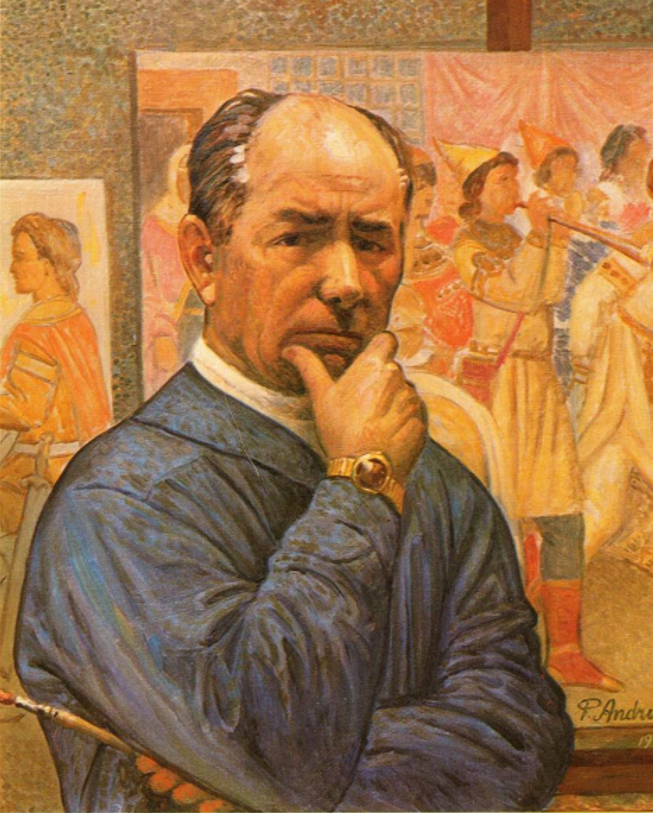
Petro Andrusiv. Self-portrait. 1977
In 1922, he found his parents in Kam’yanobrid, but… having grown up in a Russian- and Polish-speaking environment, he could not speak to them in his native language. However, he would soon not only master his parents’ language but, thanks to his interactions with the poet and journalist Anatol Kurdydyk, become a devoted Ukrainian patriot.
In 1927, despite tough competition, Petro Andrusiv was accepted as a student at the Warsaw Academy of Fine Arts. That same year, together with other Ukrainian students, he founded the ‘Spokii’ art circle, which brought forth many well-known artists. Due to a lack of funds, the artist frequently had to interrupt his studies and travel to Lviv to earn a living, where, amongst other things, he began illustrating Ukrainian books. At the same time, as a student, he received numerous awards; particularly, in 1937, he was sent on a trip to Paris in recognition of his excellent academic performance. He later taught at the High School of Architecture in Warsaw.
In the second half of the 1930s, Andrusiv responded to the tragedy of the Holodomor by creating the monumental painting ‘Golgotha of Ukraine’. Art historian and artist Bohdan Pevnyi believes that it was the artist’s first painting to ‘leave a lasting impression, as it struck its audience with its drama like no other before it’. It depicts a mountain grave made of human bodies, above which a cross bearing a crucified woman rises, symbolising the Motherland. Dark skies and birds of prey emphasise the tragedy.
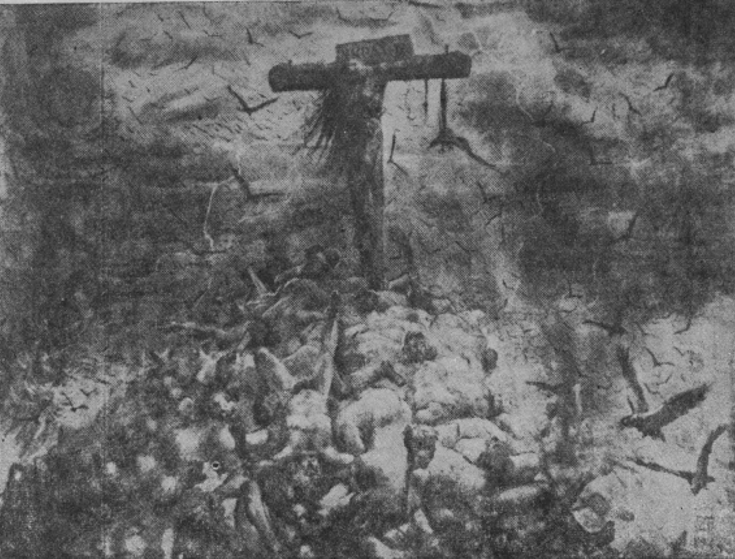
Petro Andrusiv. The Golgotha of Ukraine. Second half of the 1930s. Black-and-white photograph. From Dmytro Solovei’s book ‘The Golgotha of Ukraine’ (Winnipeg, 1953)
This work established a visual canon for depicting and experiencing the genocide of the Ukrainian nation. Unfortunately, we will never see the original. In September 1939, during the Nazi bombing of Warsaw, a bomb hit the artist’s studio. Most of his personal belongings and works, including ‘The Golgotha of Ukraine’, were destroyed in the fire. All that remains is a black-and-white photograph published in the press.
Following the Warsaw Uprising in 1944, he and his wife were taken to Germany for forced labour, then in 1947, he settled in Philadelphia, USA. He co-founded the Ukrainian Artists’ Association in the USA, which he later headed, as well as the Ukrainian Art School and the magazine Notes on Art; he created murals, mosaics, iconostases and stained-glass windows for Ukrainian churches. It was in the USA that his talent as a historical painter truly came into its own. He was particularly prolific in the historical genre after his retirement in 1972 and his move to Riverhead. His works depicted the glory of princely and Cossack Ukraine, as well as mythological subjects.
In the autumn of 1981, the artist completed his last great painting in honour of the Baptism of Ukraine-Rus’, and in December he passed away.
May the memory of Petro Andrusiv, a man of truth, remain bright…
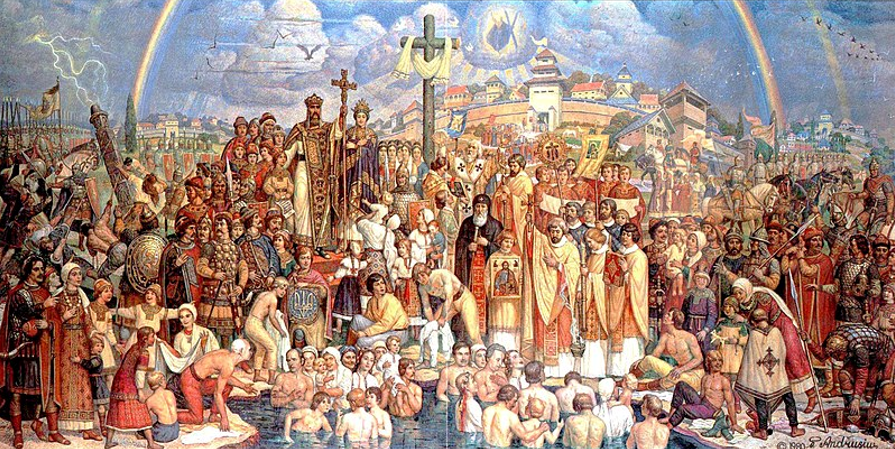
Petro Andrusiv. The Baptism of Ukraine-Rus’. 1981
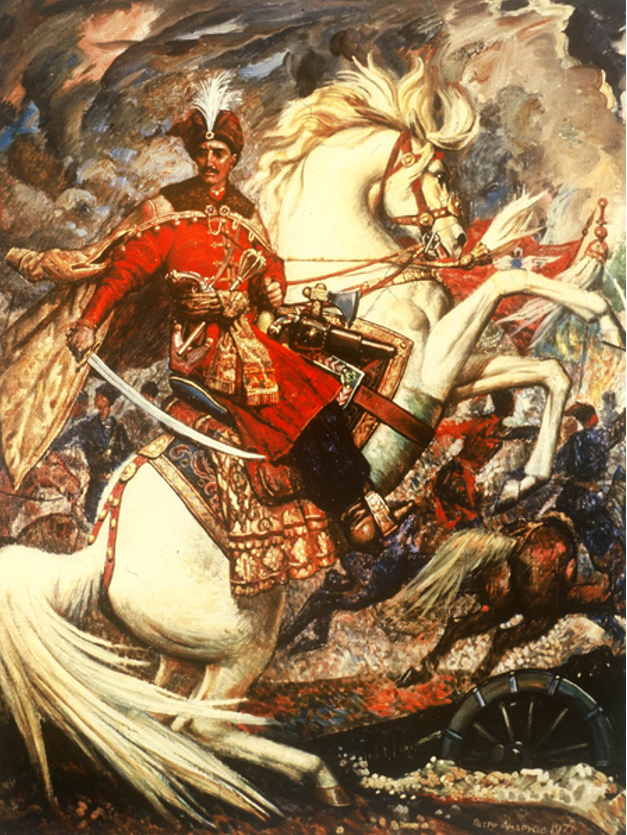
Petro Andrusiv. Hetman Ivan Mazepa. 1971
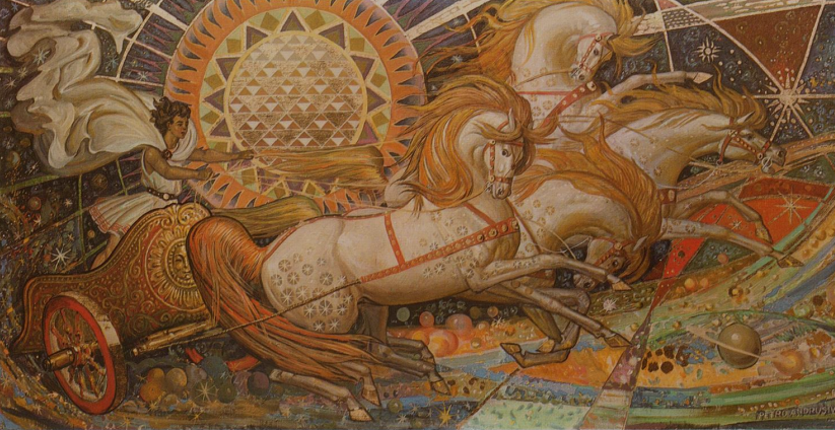
Petro Andrusiv. Phaeton. 1971