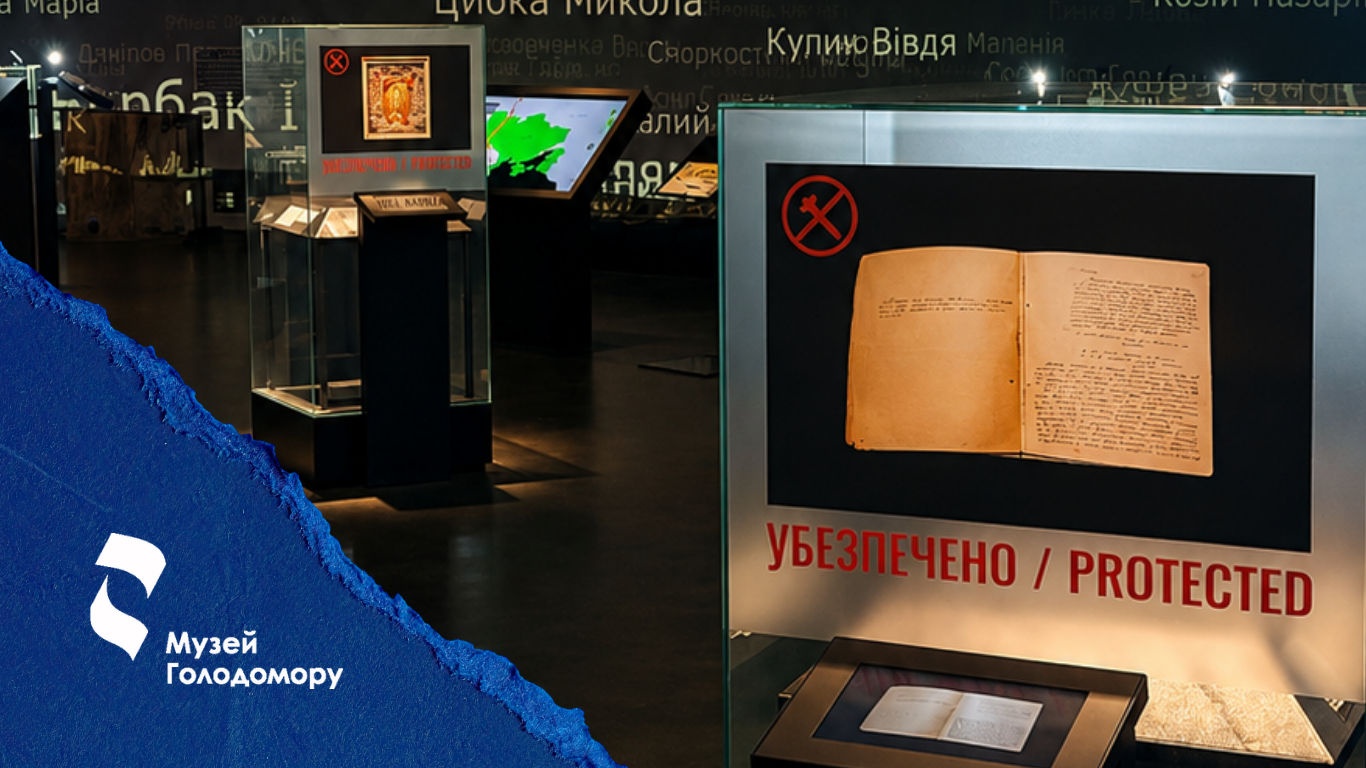
Empty display cases as a manifestation of resilience: how the Holodomor Museum’s Hall of Memory is adapting to the conditions of war
At the end of 2009, the ‘Candle of Memory’ was erected in Pechersk. Over the years, it has become a familiar feature of the local landscape. It has been somewhat forgotten that this visual symbol is merely part of a large-scale memorial complex, the National Museum of the Holodomor Genocide. For various reasons, it remains uncompleted; in particular, the main building is still awaiting completion. The construction site can be seen further down the hillside.
Consequently, to date, the Hall of Memory is the Museum’s sole point of engagement with the public. Its creator, Anatolii Haidamaka, conceived it as a place to honour the victims of the 1932–1933 genocide and, at the same time, as a self-contained artistic expression conceptually linked to the above-ground part of the memorial. However, the original installation has transformed over time.
The Hall was renovated in 2021 with patron support, updating multimedia content and installing exhibition equipment. At the end of last year, the Museum team presented its updated conceptual vision. It focuses on personal experience, as most Ukrainian families have their own stories about the Holodomor, passed down in whispers by eyewitnesses to the tragedy. It is thanks to their desperate courage that we learn about the horrors of the 1930s.
Memory was preserved not only in words but also in relics, passed down as the greatest treasure for future generations. A necklace, a book, a handkerchief: objects warmed by the touch of hands and steeped in the memories of their owners. It was precisely these exceptional items that, until recently, were on display in the Hall of Memory. Today, we do more than just commemorate the tragedy here. We speak of those who not only survived physically, but who, in defiance of the circumstances, filled their daily lives with remarkable events. Individuals whom the oppressors tried to break, but failed. After all, even the desire to preserve objects that bear witness to the crime is itself an act of their resistance and resilience.
Obviously, these are precisely the stories we need now, as we once again find ourselves at the epicentre of Russia’s genocidal attack against Ukraine. Over the years of the full-scale invasion, the Museum’s team has acquired unexpected skills. In particular, we try to analyse and anticipate the likely targets of enemy attacks.
Following the latest attacks targeting iconic historical sites, we cannot rule out the possibility that the National Museum of the Holodomor-Genocide is also a potential target for Russian missiles. Therefore, to safeguard the museum’s collections, we have taken the tough decision to alter the format of the Hall of Memory, moving the most valuable artefacts to safe locations. At the same time, replacing the original items with their images has given the Hall’s multimedia installation additional layers of meaning. The empty display cases have become a metaphor, symbolising the void left by the Russian occupier on our land: the depopulated villages of the 1930s or the frontline territories reduced to rubble today.
There is no doubt that this is a temporary situation. Just as after the Holodomor, Ukrainians will restore life to these wastelands. Today, despite the circumstances, the Museum’s team continues to develop a major exhibition to be housed in the new building of the National Museum of the Holodomor-Genocide on the banks of the Dnipro. Here, the true story of the past, which bears witness to and strengthens our resilience, will be told in full. We invite you to visit the Hall of Memory, where elements are combined into a visually evocative installation that, in our view, inspires reflection and mourning.